Extension Leads and Kettles: Common PAT Problem Areas
After enough years doing this, we repeatedly find problems among cheap, mobile and hard-worked items. That is our practical experience rather than a national failure-rate statistic. Not the expensive machinery, not the computers. It's the cheap, mobile, hard-worked things nobody thinks about, and you can check most of them yourself this afternoon.
Extension leads
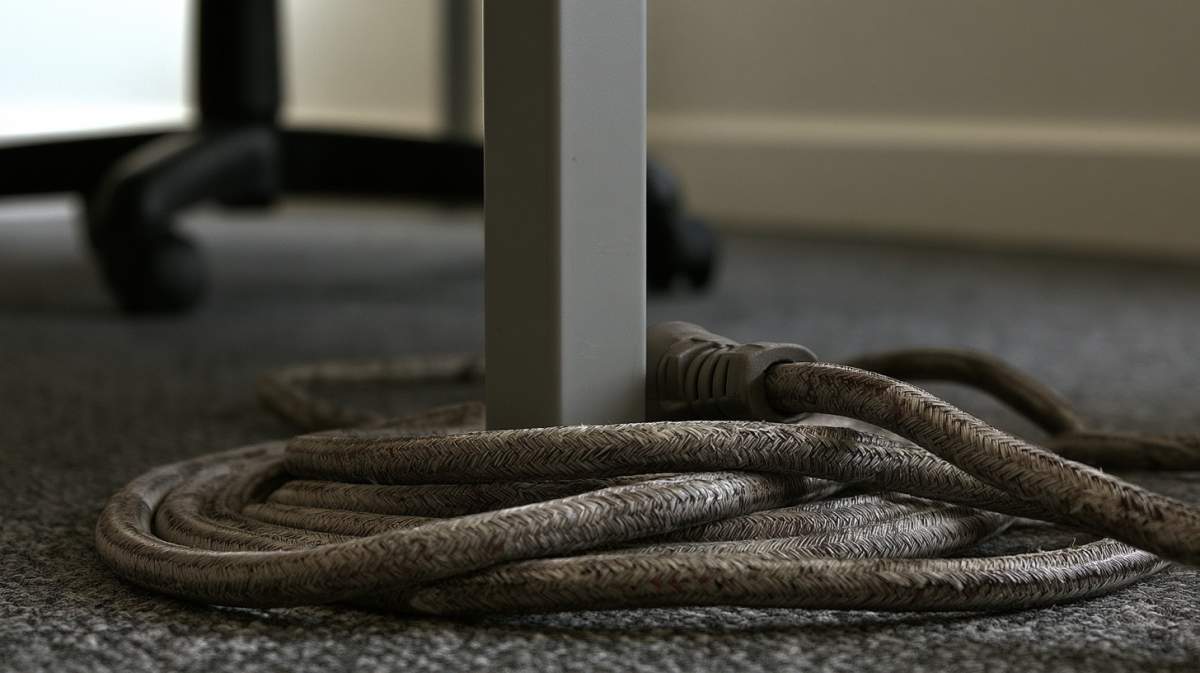
One of the most common problem areas in the buildings we test, and for obvious reasons once you look at one. They get trodden on, dragged round corners, wrapped tight round their own housing, pulled out by the cable rather than the plug, and run under desk legs. The damage concentrates where the cable enters the plug or the block, which is exactly where you can see it if you look.
The other extension lead problem isn't a fault at all, it's use: leads daisy-chained into other leads, four-ways feeding four-ways, the whole arrangement running a heater. That won't necessarily fail a test, and it's still the thing we'd point at first.
Kettles, and everything in the staff room
The staff room works harder than any other part of your building. A kettle boiled thirty or forty times a day, a toaster full of crumbs, a microwave that has been used and cleaned repeatedly. Standard PAT does not measure microwave radiation leakage; visible door or seal damage should be referred for an appropriate specialist check. Kettles fail on the lead where it flexes at the base, on the plug, and on internal insulation after years of heat and steam. If you test nothing else between visits, look at the kettle lead.
Chargers, adaptors and the things people bring in
Laptop power supplies fail at the strain point near the block, phone chargers of unknown origin turn up in every office, and travel adaptors get used as permanent fixtures. Add the personal items, the desk fan, the plug-in air freshener, the lamp from home, and you have a category that's rarely on anyone's register and frequently the worst condition equipment in the building.
Cleaning equipment and anything on wheels
Vacuums take a particular beating: cable pulled taut, run over by the machine itself, wrapped and unwrapped daily. Same for anything that gets wheeled about. Movement is what breaks equipment, which is why the vacuum fails and the wall-mounted display doesn't.
Your five-minute check
Switch off and unplug equipment before checking it. You do not need a PAT instrument for a basic user check: inspect leads and feel for flattening or nicks. Look where the cable enters the plug and the appliance for splitting or exposed cores. Check plug tops for cracks, heat marks or discolouration. Look at sockets for scorching. Look for a loose or damaged cord grip without pulling or dismantling the equipment, and refer anything doubtful to a competent person.
The HSE puts it plainly: most electrical safety defects can be found by visual examination. That's not us doing ourselves out of work, it's the most useful sentence in the whole subject. A five-minute walk round with your eyes open catches more day to day than we can catch once a year.
What it can't catch is what's happening inside: insulation breakdown, a compromised earth. That's the bit the testing is for. Our PAT testing page covers how the two fit together.
Get in touch
Found something that made you wince? Get in touch and we'll take a proper look at the rest of it.